
Tuesday & Wednesday Morning Trips
Please note that field trips require a separate registration process from meeting registration.
Ballona Freshwater Marsh Loop
Tuesday, June 24, 6:15am
Leaders: Olivia Jenkins and Bob Shanman
Length: 2 hours (approx.)
Group size limit: 30 people
Cost: $5
Transportation provided? No; participants will walk from campus
Meet at the conference registration desk (near the Life Science Building auditorium) at 6:15am. Group will be led across campus to the entrance of the marsh (approx. 1 mile), where they will meet up with the bird walk leaders 6:45am.
Start from Playa Vista Sports Park, walk across Lincoln Blvd to freshwater marsh. Approximately 1.8 mile loop around the freshwater marsh. The dirt path is flat with no steep inclines/declines. Path is not paved and can be muddy and slippery in some spots. Half of the trail is covered in wood chips. Bird checklist for the marsh can be downloaded here.
LMU Campus Bird Walk
Tuesday, June 24 & Wednesday, June 25, 6:15am
Leader: Lisa Fimiani
Length: 1.5 hours (approx.)
Group size limit: 20–30 people
Cost: $5
Transportation provided? N/A, on campus
The walk will start at the Loyola Boulevard cul-de-sac flagpoles and continue down the Mall towards the Sacred Heart Chapel and the Bluffs. We will be on paved sidewalks and dirt/gravel paths on campus, walking on even ground. The Campus is a hotspot in eBird, with 157 species recorded (https://ebird.org/hotspot/L836315). Up to 57 species of birds are most likely to be seen in June, such as Western Bluebirds (3 pairs are nesting in 3 nest boxes on Campus), Hooded Orioles (also nesting on Campus in Washingtonian Palm Fronds), American Kestrels, Cooper’s Hawks, Red-shouldered and Red-tailed Hawks, Great Horned Owls (a pair have historically been in the area, breeding one year on Campus), Cassin’s Kingbirds, Dark-eyed Juncos, Black and Say’s Phoebes, Allen’s and Anna’s Hummingbirds, American Crows and Common Ravens (ravens breed in building awnings on Campus), Bushtits, Orange-crowned Warblers, Barn Swallows (they nest in Drollinger Parking ceiling light fixtures), Song Sparrows, California and Spotted Towhees, and American Robins.
Ballona Saltmarsh / Creek
Wednesday, June 25, 6:15am
Leader: Bob Shanman
Length: 2 hours (approx.)
Group size limit: 20
Cost: $5
Transportation Provided? No, will need to carpool (sign up will be arranged at the registration desk)
Note: additional carpool drivers are needed for this field trip if possible. If you are able to drive, please email kristen.covino@lmu.edu and indicate the number of passengers that you have room for, and your field trip fee will be waived.
Meet at the conference registration desk (near the Life Science Building auditorium) at 6:15am. Participants will carpool to the entrance of the saltmarsh (dirt parking lot behind 303 Culver Blvd), where you will meet up with the bird walk leaders.
Visit the saltmarsh restoration areas through the main entrance gate at 303 Culver Blvd. Can walk through east to the outlook, then north through the marsh to the Ballona Creek. The out-and-back walk just within the Reserve would be around 0.5-1 mile. If we do the full walk in the map below that includes the Ballona Creek and looping around to see the Del Rey Lagoon, it would be around 2 miles.
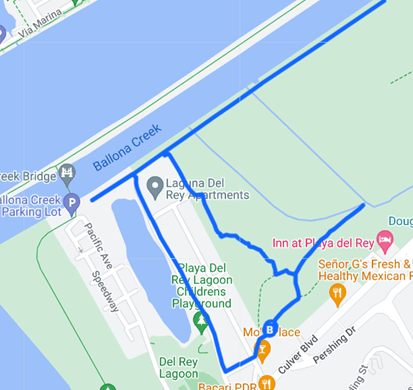
For target species see BIRDS OF BALLONA – Friends of Ballona Wetlands. Special status species include Belding’s Savannah Sparrow and California Gnatcatcher. Within the Reserve, the dirt path is flat with some gentle inclines and declines, some sandy areas, and one set of steps. The ground is paved along the Ballona Creek and on the residential streets adjacent to Del Rey Lagoon.
Post-Meeting Half-Day Trip
Sepulveda Basin (approx. 20 miles / 60 mins from LMU)
Thursday, June 26, 6:30am to 11:00am–12:00pm (traffic dependent; attendees should be aware that traffic is sometimes unpredictable and should plan on longer if arranging time-sensitive obligations after)
Leader: Tania Romero
Group size limit: 20
Cost: $10
Transportation Provided? No, will need to carpool (see below)
Note – as of now this field trip is not able to run due to a lack of carpool drivers. If you are able to drive, please email kristen.covino@lmu.edu and indicate the number of passengers that you have room for, and your field trip fee will be waived.
Meet at the conference registration desk at 6:30am. Participants will carpool to the site (Sepulveda Basin amphitheater) to meet up with the bird walk leaders. There is ample parking within a short walking distance from the amphitheater, which can be accessed from Woodley Ave; it will be on your right as you head north on Woodley Ave (if coming from the south). Upon turning you will pass the Woodley park area, archery ranges, and cricket fields. Keep going until you reach the end with a turn around area and oak trees shading the parking lot. The amphitheater will be on your right.
We will walk a loop of the Sepulveda Basin Reservoir and to a segment of the Los Angeles River. Easy to medium unpaved trail around a small lake with uneven terrain in some areas. Expect a combination of waterfowl, wading birds, raptors, and passerines. Burrowing owls can be found in disturbed dirt hedges and Bell’s Vireos can be found in the riparian areas. Multiple wading birds, shorebirds, and waterfowl can also be found including Yellowlegs, Killdeer, Black-Necked Stilts, Wood Ducks, Gadwall, and multiple grebe, heron, and egret species. Raptors are also plentiful throughout the park and can include Osprey, Red-tailed Hawk, Red-Shouldered Hawk, Peregrine Falcon, Great-Horned Owl, Cooper’s Hawk, and American Kestrel. There are also multiple woodpecker species, including the endemic Nuttall’s Woodpecker, Acorn Woodpecker, Downy Woodpecker, Hairy Woodpecker, and Red-Shafted Northern Flicker. Four species of hummingbirds can also be potentially found here during this time including Anna’s Hummingbird, Allen’s Hummingbird, Costa’s Hummingbird and Black-chinned Hummingbird. The area is a combination of open grassy areas, riparian, barren fields, and oak woodlands, therefore plentiful passerine species can be found including multiple resident endemic species such as California Towhee, California Scrub-jay, California Thrasher, and Wrentits. Migratory summer breeders or transients can also be found in the park including Western Tanagers, Black-headed Grosbeak, Blue Grosbeak, Lazuli Bunting, Ash-throated Flycatchers, Yellow Warblers, and Hooded Orioles, and Yellow-breasted Chat. Other passerine birds can also include multiple goldfinch, wren, flycatcher, and sparrow species.
 WOS 2025